
Tuberous sclerosis complex (TSC) is a genetic disorder that causes non-malignant tumors to form in many different organs, primarily in the brain, eyes, heart, kidney, skin, and lungs. Changes in the brain caused by TSC have the biggest impact on quality of life, from seizures and developmental delays to intellectual disabilities, behavioral challenges, and autism. Importantly, 60-70% of TSC patients have a mutation in the Tsc2 gene.
Through our work with the TSC Alliance®, we have focused our efforts on characterizing mouse models of TSC and offering robust and reproducible protocols and assays for the preclinical screening of novel therapies as part of the TSC Preclinical Consortium. The TSC Alliance fuels collaborative research through the Preclinical Consortium making preclinical testing resources available to academic and pharmaceutical industry researchers to de-risk drug development in TSC and move new treatments to clinical trials faster.
For testing the efficacy of novel therapeutics to treat TSC, the most commonly used preclinical model is the well-established Tsc1-GFAP-Cre mouse model. Recently, we have established the Tsc2-GFAP-Cre and Tsc2 stochastic mouse models which have a more robust phenotype for seizures and mortality. The Tsc2 KO models can offer a greater phenotypic range for evaluating therapeutic efficacy and, for some therapeutics, could provide better target specificity.
Tsc1 CKO vs. Tsc2 CKO Mice
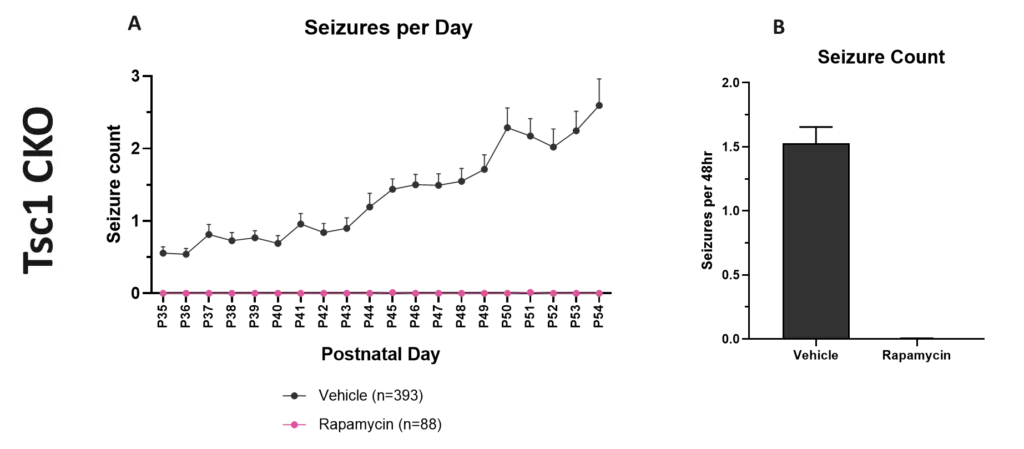
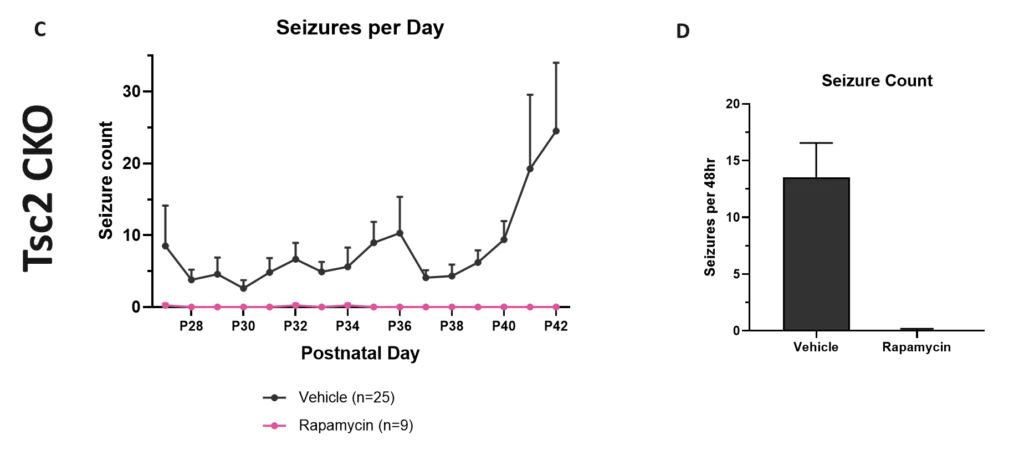
Historical data from Tsc1 CKO (A and B) and Tsc2 CKO (C and D) mice. Tsc1 CKO mice exhibit a progressive seizure phenotype (A) which worsens from P35 to P54, with an overall average seizure rate of about 1.5 seizures per 48 hours (B). Seizures are completely prevented in Tsc1 CKO mice when treating with 3 mg/kg rapamycin daily. Tsc2 CKO mice exhibit a more robust seizure phenotype that is also progressive (C), worsening from P37 to P42. The overall seizure rate is about 13.5 seizures per 48 hours (D). Seizures are almost completely prevented in Tsc2 CKO mice when treating with a 3 mg/kg rapamycin daily.
Note the differences in the Y axes between the Tsc1 and Tsc2 KO graphs.
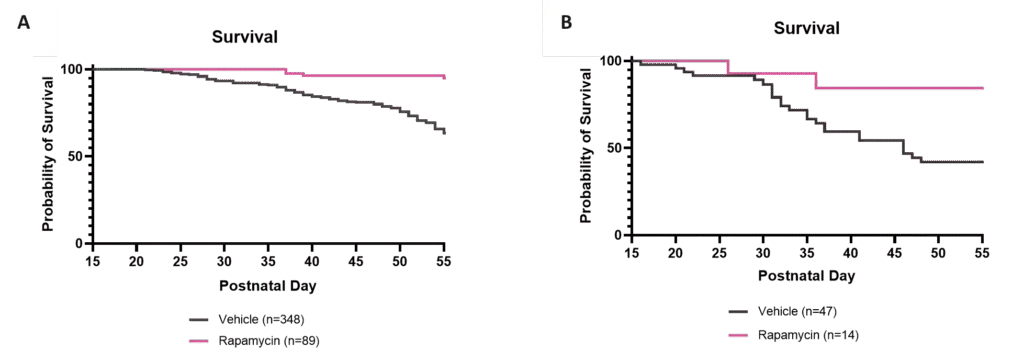
Spontaneous death occurs in both models, with (A) ~35% of Tsc1 CKO mice and (B) ~60% of Tsc2 CKO mice dying by P55. Treatment 3 mg/kg rapamycin daily improves seizures in both models but does not completely prevent death.
All data presented were generated with the TSC Alliance.
TSC Alliance: Our Partner for TSC Research
“The TSC Alliance is an internationally recognized nonprofit that does everything it takes to improve the lives of people with TSC. We drive research, improve quality care and access and advocate for all affected by the disease. The TSC community is our strongest ally. The collaboration of individuals and families, along with the partnership of other organizations, fuels our work to ensure people navigating TSC have support – and hope – every step of the way.”
Learn more about the TSC Alliance, their pioneering research, and their advocacy for the TSC community at TSCAlliance.org or by contacting: Dean Aguiar at daguiar@tscalliance.org or Zoë Fuchs at zfuchs@tscalliance.org.